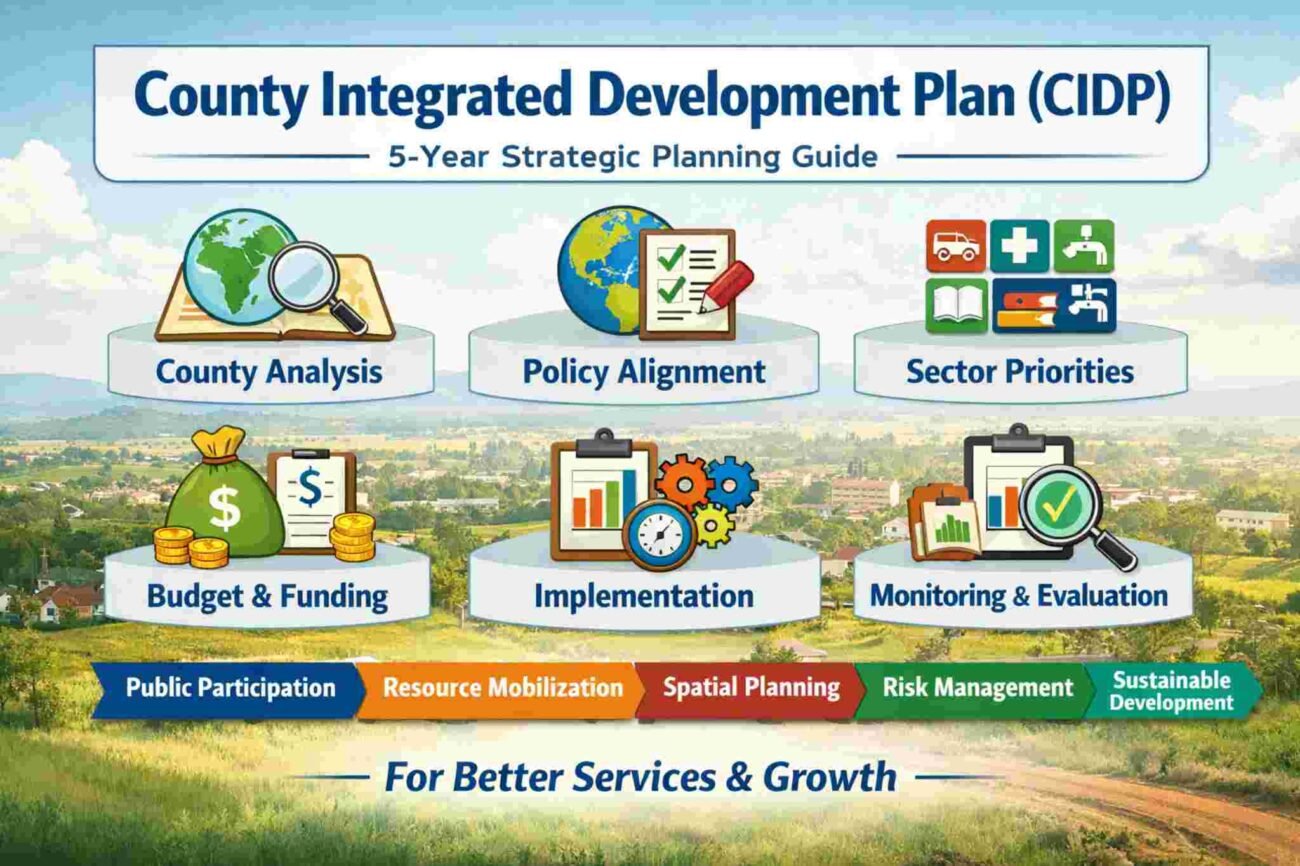
A County Integrated Development Plan (CIDP) is a five-year plan that guides development in a county. It explains what the county wants to achieve, how it will do it, how much it will cost, and how progress will be checked.
The CIDP is very important because it connects planning with budgeting. This means the county should only spend money on projects that are written in the plan. It also makes sure that development is organized, fair, and focused on real community needs.
1. Why a CIDP is Important
A CIDP helps a county to:
-
Plan development for five years
-
Use money wisely
-
Avoid wasting resources
-
Involve citizens in decision-making
-
Improve service delivery
-
Track progress of projects
-
Promote transparency and accountability
Without a CIDP, projects may be done randomly without clear direction.
2. County Background Information
The first part of the CIDP explains the county’s situation. This helps leaders understand the problems and opportunities before making plans.
2.1 Areas Covered in Background Analysis
| Area | What is Included | Why It Matters |
|---|---|---|
| Location | Size, borders, climate | Helps plan infrastructure and farming |
| Population | Total number, age groups | Helps plan schools and hospitals |
| Economy | Jobs, income levels | Shows poverty and business needs |
| Infrastructure | Roads, water, electricity | Shows development gaps |
| Natural Resources | Land, forests, water | Shows economic potential |
This information helps leaders make good decisions based on facts.
3. Link with National and Global Goals
A CIDP must follow national laws and policies. It should also support global goals like climate protection and poverty reduction.
3.1 Levels of Alignment
| Level | Example | Purpose |
|---|---|---|
| National | Constitution, development policies | Ensure legal compliance |
| Regional | Regional development plans | Promote cooperation |
| Global | Sustainable Development Goals (SDGs) | Support global progress |
This alignment ensures that the county works together with the national government and other partners.
4. Review of the Previous Plan
Before making a new plan, the county checks the old one.
It looks at:
-
Which projects were completed
-
Which projects are still ongoing
-
Which projects failed
-
How money was used
-
Challenges faced
-
Lessons learned
4.1 Example of Plan Review
| Project Type | Status | Lesson Learned |
|---|---|---|
| Road Projects | Mostly completed | Good supervision helped |
| Water Projects | Partly done | Not enough funds |
| Health Centers | Completed | Strong planning worked |
| Youth Programs | Weak results | Poor monitoring |
This review helps avoid repeating mistakes.
5. Development Priorities by Sector
The main part of the CIDP explains what each sector plans to do.
5.1 Common Sectors in a CIDP
-
Agriculture
-
Health
-
Education
-
Water and sanitation
-
Roads and transport
-
Trade and industry
-
Environment
-
Youth and social services
-
Public administration
Each sector includes:
-
Problems in that sector
-
Goals to solve the problems
-
Projects to achieve the goals
-
Indicators to measure progress
5.2 Example of Sector Planning
| Sector | Problem | Goal | Project |
|---|---|---|---|
| Agriculture | Low crop production | Increase food supply | Build irrigation systems |
| Health | Few health centers | Improve health access | Construct new clinics |
| Roads | Poor rural roads | Improve transport | Repair roads |
| Youth | High unemployment | Create jobs | Offer skills training |
This helps ensure every sector has clear direction.
6. Spatial Planning
Spatial planning shows where development will take place. It helps organize land use properly.
6.1 Areas Covered in Spatial Planning
-
Urban growth areas
-
Farming zones
-
Industrial zones
-
Protected environmental areas
-
Infrastructure corridors
Benefits of Spatial Planning
-
Prevents land conflicts
-
Protects the environment
-
Supports organized urban growth
-
Improves service delivery
It ensures development happens in the right places.
7. Implementation Plan
Planning alone is not enough. The CIDP explains how projects will be carried out.
7.1 Roles and Responsibilities
| Group | Role |
|---|---|
| County Executive | Leads development |
| County Assembly | Approves and oversees |
| Departments | Implement projects |
| Citizens | Give feedback |
| Partners | Provide funding or support |
7.2 Implementation Details Include
-
Project timelines
-
Estimated costs
-
Responsible department
-
Monitoring plans
Clear roles reduce confusion and delays.
8. Resource Mobilization (How Projects Are Funded)
Projects need money. The CIDP explains where the money will come from.
8.1 Main Sources of Revenue
-
National government funds
-
Local taxes and fees
-
Grants
-
Donor support
-
Public-private partnerships
8.2 Example of Funding Sources
| Source | Contribution | Reliability |
|---|---|---|
| National Funds | High | Stable |
| Local Revenue | Medium | Depends on collection |
| Donor Support | Low | Not guaranteed |
| Partnerships | Growing | Depends on investors |
Good financial planning ensures projects are realistic.
9. Monitoring and Evaluation (M&E)
Monitoring and Evaluation (M&E) helps check whether projects are working.
9.1 Types of Indicators
-
Output – What was built or delivered
-
Outcome – Changes seen after implementation
-
Impact – Long-term improvements
9.2 Example of M&E Table
| Goal | Indicator | Starting Level | Target | Review Time |
|---|---|---|---|---|
| Improve water access | % households with clean water | 40% | 70% | Yearly |
| Improve health services | Doctor-patient ratio | 1:5000 | 1:3000 | Every 6 months |
Regular reporting improves accountability and learning.
10. Risk Management and Cross-Cutting Issues
Every plan faces risks. The CIDP identifies possible risks and solutions.
10.1 Common Risks
-
Climate change
-
Floods or droughts
-
Political conflicts
-
Economic problems
-
Low revenue collection
10.2 Cross-Cutting Issues
These issues must be included in all sectors:
-
Gender equality
-
Youth empowerment
-
Disability inclusion
-
Environmental protection
-
Anti-corruption
-
Disaster management
This ensures development benefits everyone.
11. Annexes
The last section contains extra information such as:
-
Detailed project lists
-
Budget tables
-
Public participation reports
-
Maps
-
Data tables
These documents support transparency.
Conclusion
A County Integrated Development Plan (CIDP) is a very important tool for county development. It helps leaders plan properly, spend money wisely, and improve services for citizens.
The CIDP:
-
Is based on real data
-
Involves community participation
-
Aligns with national and global goals
-
Includes clear budgets and timelines
-
Tracks progress through monitoring
-
Promotes accountability and transparency
When well prepared and implemented, a CIDP improves the quality of life for people in the county. It supports economic growth, better services, and sustainable development.
