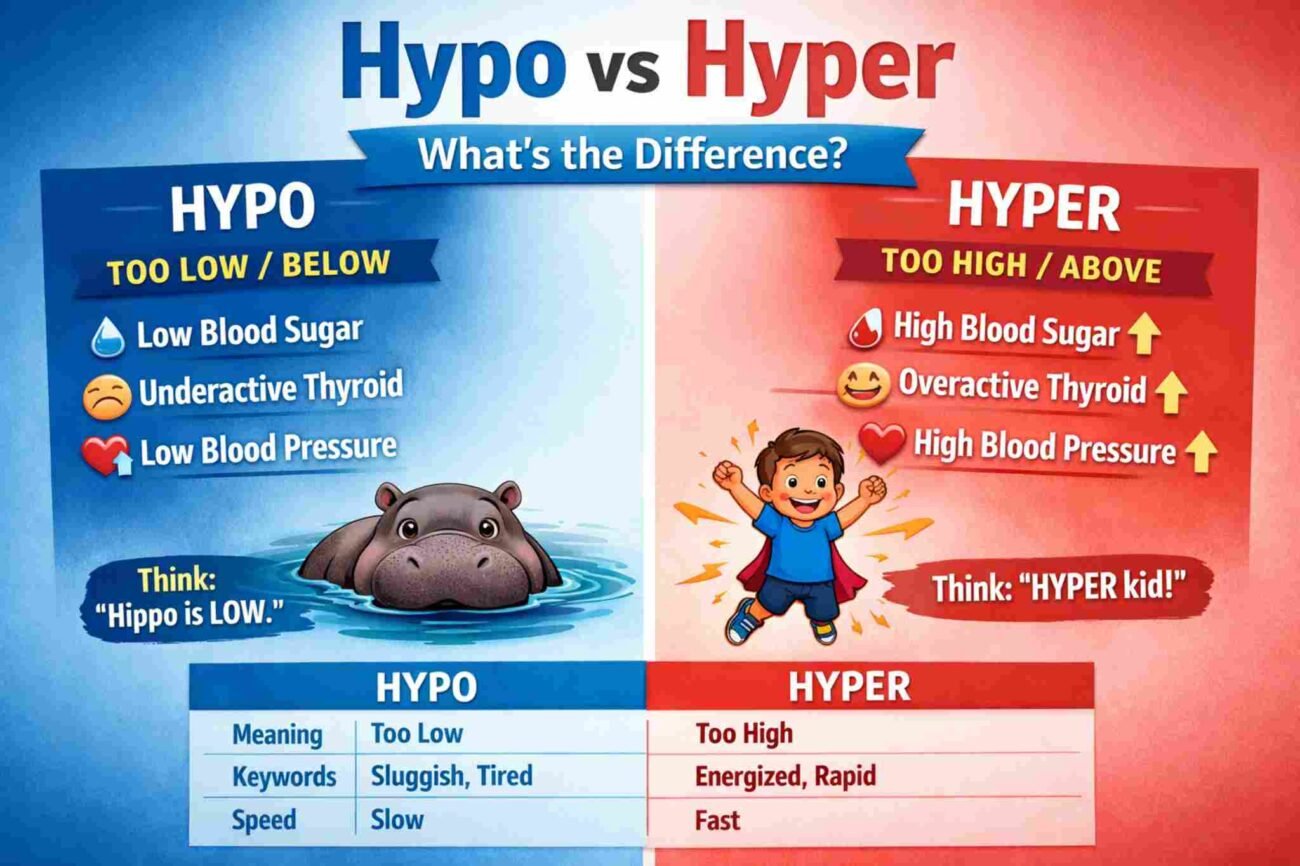
The words hypo and hyper are short, but they are very important. You will often see them in medical terms. They help explain whether something in the body is too low or too high.
Here is the simple meaning:
-
Hypo = too low
-
Hyper = too high
That’s the main difference. Once you understand this, many medical words become easier to understand.
Quick Comparison
| Word | Simple Meaning | What It Describes |
|---|---|---|
| Hypo | Too low | Not enough |
| Hyper | Too high | Too much |
You can also remember it like this:
-
Hypo = Low
-
Hyper = High
What Does “Hypo” Mean?
The prefix hypo means something is below normal or not enough.
When doctors use this word, they mean a level in the body is lower than it should be.
Hypo Often Means:
-
Low levels
-
Slow activity
-
Weak or reduced function
Examples of Hypo Words
| Word | Meaning |
|---|---|
| Hypoglycemia | Low blood sugar |
| Hypotension | Low blood pressure |
| Hypothyroidism | Low thyroid hormone |
| Hypothermia | Low body temperature |
If you see “hypo,” think:
Something is too low.
What Does “Hyper” Mean?
The prefix hyper means something is above normal or too much.
Doctors use this word when a level in the body is higher than it should be.
Hyper Often Means:
-
High levels
-
Fast activity
-
Overactive function
Examples of Hyper Words
| Word | Meaning |
|---|---|
| Hyperglycemia | High blood sugar |
| Hypertension | High blood pressure |
| Hyperthyroidism | High thyroid hormone |
| Hyperthermia | High body temperature |
If you see “hyper,” think:
Something is too high.
How These Words Are Built
Many medical words have three parts:
-
Prefix (hypo or hyper)
-
Root word (what body part or substance)
-
Ending (shows it is a condition)
Read also: Fiebrigen
Example
| Word | What It Means |
|---|---|
| Hypoglycemia | Low sugar in the blood |
| Hyperglycemia | High sugar in the blood |
| Hypothyroidism | Low thyroid activity |
| Hyperthyroidism | High thyroid activity |
If you understand the prefix, you can understand the word.
Hypo vs Hyper: Blood Sugar
Blood sugar problems are a common example.
Hypoglycemia (Low Blood Sugar)
This means blood sugar is too low.
Common Signs
-
Shaking
-
Sweating
-
Feeling weak
-
Feeling confused
-
Fast heartbeat
Serious Signs
-
Fainting
-
Seizures
-
Passing out
What Can Cause It?
-
Not eating enough
-
Too much insulin
-
Hard exercise
-
Some medicines
What To Do
-
Eat or drink something with sugar (like juice)
-
Rest
-
Get medical help if symptoms are severe
Low blood sugar can happen quickly, so it needs fast action.
Hyperglycemia (High Blood Sugar)
This means blood sugar is too high.
Common Signs
-
Very thirsty
-
Peeing often
-
Feeling tired
-
Blurry vision
-
Headache
Serious Signs
-
Feeling sick to your stomach
-
Vomiting
-
Trouble breathing
-
Very dry mouth
What Can Cause It?
-
Missing insulin
-
Eating too much sugar or carbs
-
Stress
-
Illness
What To Do
-
Check blood sugar
-
Drink water
-
Follow doctor’s advice
-
Seek medical help if it gets worse
High blood sugar usually builds up slowly, but it can still be dangerous.
Blood Sugar: Side-by-Side
| Feature | Hypoglycemia | Hyperglycemia |
|---|---|---|
| Sugar Level | Too low | Too high |
| How Fast It Happens | Often fast | Often slow |
| Main Feeling | Shaky, weak | Thirsty, tired |
| Immediate Risk | Can be urgent quickly | Risk grows over time |
Hypo vs Hyper: Thyroid Problems
The thyroid is a small gland in your neck. It controls how fast your body works (your metabolism).
Hypothyroidism (Low Thyroid)
This means the thyroid is not active enough.
Signs
-
Feeling very tired
-
Weight gain
-
Feeling cold
-
Slow heartbeat
-
Dry skin
What Happens?
Your body slows down.
Treatment
Doctors usually give thyroid hormone medicine.
Hyperthyroidism (High Thyroid)
This means the thyroid is too active.
Signs
-
Weight loss
-
Fast heartbeat
-
Feeling nervous
-
Sweating
-
Feeling hot
What Happens?
Your body speeds up.
Treatment
Doctors may give medicine or other treatments to slow it down.
Thyroid Comparison
| Feature | Hypothyroidism | Hyperthyroidism |
|---|---|---|
| Hormone Level | Too low | Too high |
| Body Speed | Slower | Faster |
| Weight | Gain | Loss |
| Heart Rate | Slow | Fast |
| Temperature Feeling | Cold | Hot |
Simple Patterns to Remember
Most of the time:
Hypo Conditions
-
Slow
-
Low
-
Cold
-
Weak
Hyper Conditions
-
Fast
-
High
-
Hot
-
Overactive
Easy Memory Tricks
Here are simple ways to remember:
-
Hypo sounds like “hippo.”
Imagine a hippo low in the water → low = hypo. -
Hyper sounds like “hyper kid.”
A hyper kid has too much energy → too much = hyper.
Or just remember:
-
Hypo = Low
-
Hyper = High
When to Get Medical Help
You should get medical help right away if you have:
-
Confusion
-
Fainting
-
Seizures
-
Severe chest pain
-
Trouble breathing
-
Very strong or worsening symptoms
Both low and high levels in the body can be dangerous if not treated.
Final Summary
The difference between hypo and hyper is simple:
| Hypo | Hyper |
|---|---|
| Too little | Too much |
| Below normal | Above normal |
| Low | High |
When you see these words, ask yourself:
Is this describing something that is too low or too high?
That one question will help you understand many medical terms.
Knowing the difference can help you better understand your health and talk more clearly with doctors.
